 Electric Reel Lab
Electric Fishing Reel Comparison Evidence
This is the detailed research behind our short electric-reel decision guide. Use it for full specifications, fishing-method explanations, price ladders, setup checks, and source evidence.
Reach — An electric reel can turn water that feels too deep to fish repeatedly into a practical next fishing ground. It does not find the fish or make it bite. It retrieves hundreds of feet of line and a heavy rig so the angler can reset after a missed mark, follow the next drift and spend more of the day presenting bait.
That opens a compelling question for an offshore angler who has never owned one: what lives below the water you normally fish? Florida's wildlife agency places tilefish on the outer continental shelf and upper slope in roughly 250–1,500 ft of water. Its swordfish profile describes a deep-sea fish found from the surface to below 2,000 ft. Regulations, seasons and practical methods vary, but the opportunity is real: an electric reel makes repeated access to deep water more manageable rather than making the fishing automatic.
The fastest way to narrow the reel field is to start with that fishing job. Are you retrieving a deep-drop rig from a rod holder, working a lighter setup in hand, flying a kite, or carrying enough heavy braid for a big offshore target? Depth matters, but you do not need to know an exact number before you begin.
This guide starts with species and fishing style, then checks line capacity, reel format and electrical demand. It covers current US-market examples from Daiwa and Shimano. Prices and availability should be checked again before purchase.
Use this page as the decision hub. Continue to the saltwater fishing-job guide for deep-drop, kite, teaser and in-hand use cases; the Daiwa size guide or Shimano comparison for brand-specific choices; the Seaborg versus Tanacom guide when the handling style is still open; and the Tanacom 1200 guide when that model reaches the final shortlist.
There is another fishing world below
Deep water changes the job before it changes the reel. More line leaves the spool, current can carry the rig away from the vertical depth, and every unproductive drift still ends with the sinker and terminal tackle coming back to the boat.
That is the transformation an electric reel sells:
- More practical resets: retrieve an empty or misplaced rig without making the manual wind the main event.
- More chances to stay on the mark: recover, reposition and drop again when drift carries the presentation away from structure.
- Access with less repetitive strain: preserve energy for rigging, watching the rod, managing drag and landing the fish.
- Repeatable depth work: use the reel's counter and controlled retrieve as aids while the angler still chooses the ground, bait, rig and timing.
The target fish depends on coast, season, rules and method. For a US-oriented starting map:
| Deep-water possibility | What makes it compelling | What must be confirmed before the trip |
|---|---|---|
| Golden or blueline tilefish | Bottom fish associated with the outer shelf and slope; Florida describes tilefish habitat at roughly 250–1,500 ft | Current state or federal season, permit, bag limit, hook and descending-device rules |
| Deep-water grouper and snapper | Daiwa names grouper, snapper and tilefish among the US Seaborg 300J-DH's deep-drop targets beyond 1,000 ft | Exact species, legal depth/area, terminal tackle, release obligations and the captain's line plan |
| Daytime swordfish | A large offshore target associated with extreme depth; Florida describes swordfish from the surface to below 2,000 ft | HMS permit/reporting requirements, current rules, boat capability and a method-specific outfit |
These are doors into a fishing style, not promises that one reel catches every species. Start with the fish and boat, then let depth, line class, rig weight, power and handling decide the reel.
Meet the swordfish behind the deep-water challenge
Swordfish are open-ocean predators with a long, flattened bill and large eyes. NOAA's North Atlantic swordfish profile describes them slashing that bill through prey, then feeding on fish and squid. Specialized eye muscles and a heat-exchange system help them hunt in deep, cold water. They feed throughout the water column—not only near the bottom. (Source checked September 4, 2026.)
Plan the presentation depth with the captain, then match the outfit to that method.
If tilefish is the fish that opened this door, use the Florida Tilefish Trip Planner to settle the coast, current rules, boat questions, line plan and release equipment before comparing reels.
The short answer
| Fishing job | Start with | Why it belongs on the shortlist | Confirm before buying |
|---|---|---|---|
| General deep dropping and kite fishing | Daiwa Tanacom family | Straightforward 12 V power assist, large line-guide options and US-market support | Required braid capacity, power source and whether the reel will stay in a holder |
| Heavy deep-drop or kite work with large line capacity | Daiwa Tanacom 1200 | Daiwa publishes 1,100 yd of 80 lb J-Braid capacity, 50 lb maximum drag and 140 m/min maximum retrieval speed | Total loaded weight, rod and holder strength, cable route and boat circuit |
| Lighter in-hand deep dropping or deep jigging | Daiwa Seaborg 300J-DH or 500J class | Compact format and thumb-operated power control preserve more of the rod-and-reel fight | Capacity for the intended depth, sinker and target; US model availability |
| Maximum-capacity Shimano US option | Shimano Beastmaster 9000 B - official US product page | Shimano publishes 1,030 yd of 80 lb PowerPro capacity, 55 lb maximum drag and a 40 A maximum-current specification | A power source and wiring path suited to the published current demand |
| Premium two-speed electric work | Daiwa Seaborg 800MJ - official US product page | Switchable high/low MegaTwin gearing and a published 20 A maximum-current figure | Whether the premium price solves a real need in the intended fishing job |
These are starting points, not universal species assignments. A charter captain's required line class, terminal rig and power rules take priority over a generic table.
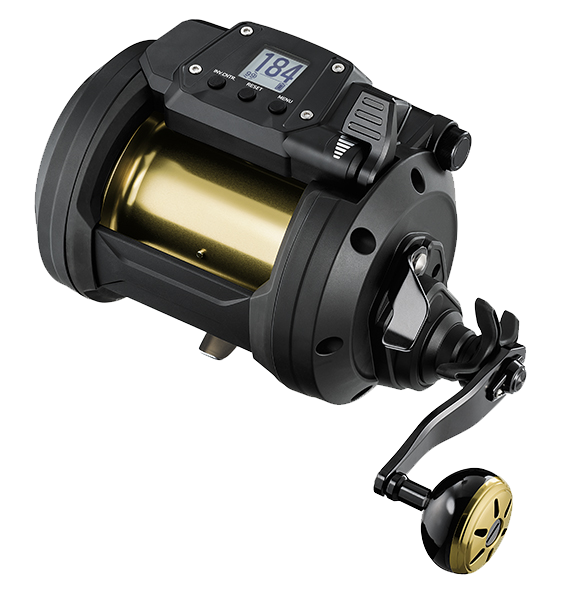
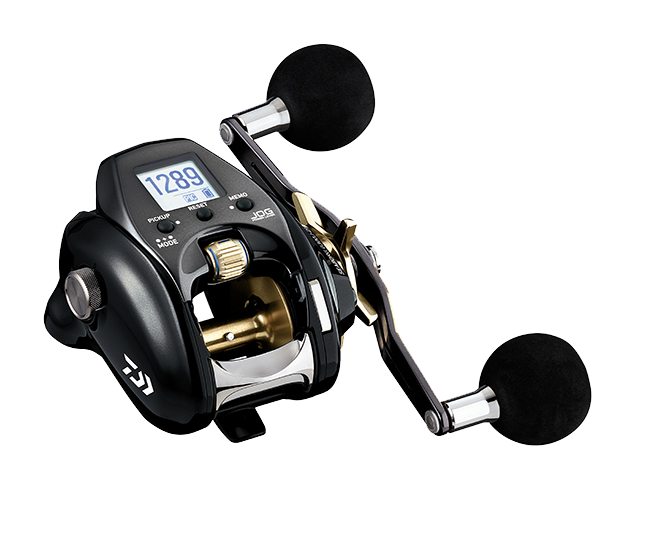
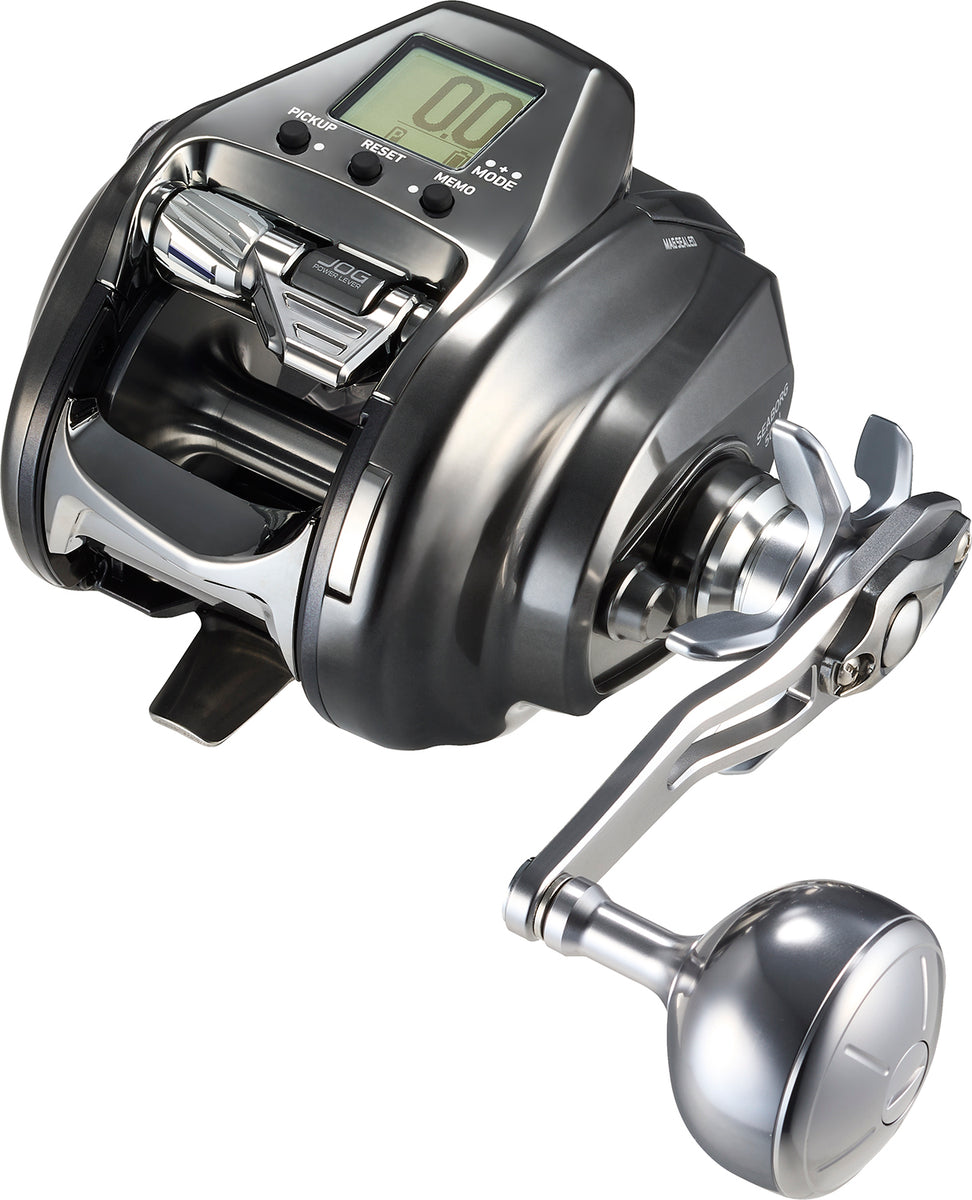
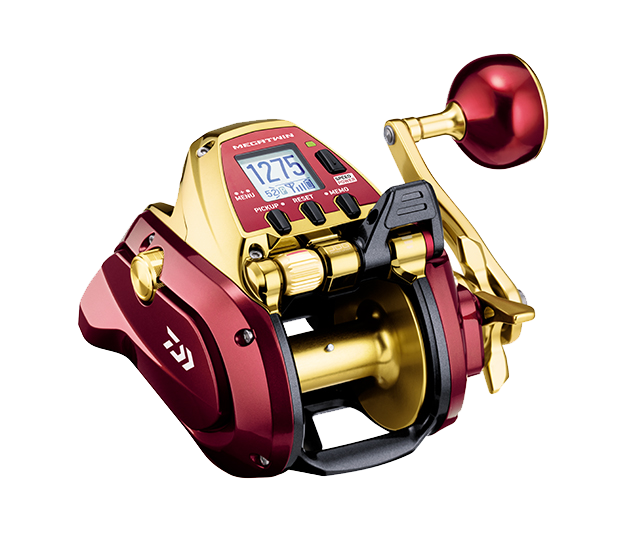
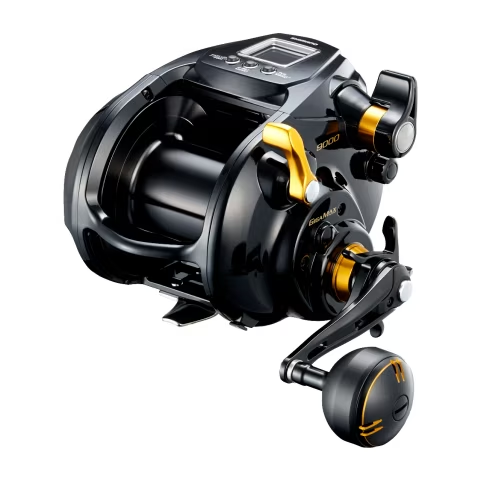
Product images: Daiwa US and Shimano North America Fishing. Each image is matched to the named US model or generation.
What buyer questions keep repeating
Across product reviews and setup discussions, the same problems appear behind different model names. They are more useful than a generic star average because each one changes the cart.
Choose by fishing job, not by model number
Deep dropping from a rod holder
This is the clearest case for a large electric reel. Long retrieves, heavy sinkers and repeated drops make capacity and sustained winding ability more important than a compact body.
Begin with four numbers:
- The line class required by the captain or rig.
- The length of line needed, including a usable reserve beyond the fishing depth.
- The reel's published power-supply range and maximum current.
- The combined weight and mounting demands of the loaded reel, rod and terminal tackle.
The Daiwa Tanacom 1200 is an obvious US-market reference point because Daiwa publishes 1,100 yd of 80 lb J-Braid capacity, a 50 lb maximum drag and 12 V power assist. The Shimano Beastmaster 9000 B is another high-capacity reference: Shimano's North American manual lists 1,030 yd of 80 lb PowerPro, 55 lb maximum drag and 40 A maximum current.
Those figures are not directly interchangeable. Maximum drag, practical winding power and momentary winding power describe different tests. Treat each as its own specification instead of blending them into a single “power” ranking.
Fishing the reel in hand
A smaller electric reel changes the experience. Rather than leaving the outfit in a holder and asking the motor to handle every retrieve, the angler can feel the bite, set the hook and work the rod while using power assist when it helps.
Daiwa positions the Seaborg 300J-DH for in-hand deep dropping and deep jigging, including depths beyond 1,000 ft. Its named target examples include grouper, snapper and tilefish. Daiwa positions the newer Seaborg 500J between in-hand and holder-mounted use, with 440 yd of 50 lb braid capacity.
The decision condition is capacity. A compact reel is attractive only if it carries the line class and reserve the fishing plan requires.
Kite fishing
Kite fishing places different value on line handling. Daiwa highlights the Tanacom 1200's oversized line-guide aperture because it can pass larger knots and kite swivels. That is a functional reason to choose it beyond raw drag or retrieval speed.
Confirm the exact kite setup, line connections and rod arrangement before treating any large electric reel as interchangeable. The useful question is not “Can it retrieve line?” but “Can the entire rig pass, stop and reset the way this boat fishes it?”
Occasional power assist
An electric reel is not automatically the best answer for every offshore trip. If the fishing is shallow, retrieves are short, the tackle is light and physical assistance is not needed, a conventional reel may be simpler and less expensive as a complete system.
The electric choice earns its place when it changes the day: more deep drops with less fatigue, reliable retrieval of heavy terminal tackle, controlled kite-line work, or access to a fishing style that would otherwise be impractical.
What if you do not know the depth?
You can still narrow the choice.
Start with the target species and fishing method. Then ask the charter, head boat or local tackle shop for its recommended line class, sinker range and typical depth band. Recreational fishing guidance from Take Me Fishing recommends local research, bait shops and guides when finding fishing spots; it describes fishfinders as tools that show fish and their depth. Garmin fishing charts add bottom contours that help boaters identify depth changes and underwater structure.
Use depth as a verification step:
- If you know the approximate depth, check that the reel carries the required line plus a practical reserve.
- If you do not, get the boat's tackle recommendation before choosing capacity.
- If you will fish several regions, size for the most demanding planned use rather than the easiest trip.
Buying far more reel than the fishing requires adds cost and weight. Buying too little capacity can make the outfit unsuitable before the first drop.
Before your first deep-drop trip: ask the boat these seven questions
The most useful first purchase may be a conversation, not a reel. A captain or tackle shop can turn a vague interest in tilefish, deep-water grouper or daytime swordfish into the exact fishing job the outfit must perform.
Ask these before filling the cart:
- Which exact species and area are we fishing? Similar-looking fish can fall under different state or federal rules.
- What depth band do you normally fish, and how much extra line do you want beyond it? Current can create substantial scope, so water depth alone is not the full capacity requirement.
- What braid class, leader and sinker range do you require? Use the boat's working rig as the input to the reel decision.
- Will the outfit stay in a holder or be worked in hand? This decides whether maximum capacity or compact control matters more.
- What power is available at the fishing position? Confirm voltage, outlet, current capacity, connector and whether a separate battery is permitted.
- Which permit, season, bag-limit and release rules apply on the trip date? Florida publishes separate current pages for tilefish, billfish and reef-fish gear; check the responsible state and federal agencies for the actual destination.
- What must the angler bring, and what does the boat supply? Confirm reel, rod, braid, terminal tackle, battery, cable, mounting hardware and spare connections one item at a time.
This checklist prevents the most expensive mistake in electric-reel shopping: buying an impressive reel before defining the boat, rig and target it must support. Once the seven answers are known, use the comparison tables below to choose only as much reel as the trip needs.
The five specifications that matter
1. Line capacity in the line you will actually use
Do not compare a PE-number capacity from one page with a pound-test capacity from another as if they were the same measurement. Diameter varies by line product. Use the reel maker's published table, then verify the selected braid's stated diameter and the amount the retailer will spool.
Capacity is not just “more is better.” It should cover fishing depth, scope or line angle, terminal losses and a usable reserve.
Use the electric-reel braid capacity guide to turn the captain's depth and line-class answer into an installed-length and spooling specification before choosing the reel.
2. Practical winding ability
Manufacturers publish several power terms. Shimano's Beastmaster manual distinguishes maximum drag, practical power, no-load speed and loaded retrieval speeds. Daiwa pages may publish maximum drag, maximum winding power or momentary winding power depending on model.
Keep the labels attached to the figures. A dramatic momentary number does not by itself describe how a reel retrieves a working rig repeatedly through the day.
3. Power voltage and maximum current
“12 volt” is only the beginning of the electrical decision.
The Daiwa Seaborg 800MJ page states a 12–16.8 V acceptable range and 20 A maximum use. Shimano's Beastmaster 9000 B manual states DC 12 V and 40 A maximum current. Those published figures show why the reel, battery or boat outlet, protective device, connectors and cable run must be considered together.
Before buying, confirm:
- The reel's permitted voltage range.
- Its published maximum current.
- Whether the boat provides a compatible outlet.
- Whether the captain allows a separate battery.
- The connector and cable arrangement.
Do not estimate runtime from battery amp-hours alone. Real use depends on load, duty cycle, voltage behavior, wiring and battery limits. Use the electric-reel battery guide to compare boat power and separate-battery scenarios with those assumptions visible.
4. In-hand versus holder-mounted use
Large capacity is useful, but weight changes how the outfit is fished. Daiwa explicitly positions its compact Seaborg models around in-hand control, while the Tanacom 1200's capacity and offshore role make it a natural holder-oriented reference for many heavy jobs.
Choose the experience you want as well as the capacity you need.
5. US-market support versus a JDM import
A lower import price can be attractive, but the model name alone does not answer language, included cable, voltage instructions, warranty channel, parts or service handling.
For the initial shortlist, this guide prioritizes models shown on Daiwa US or Shimano's US product pages. JDM models will be compared separately with their exact manuals and support conditions instead of being mixed into US products by size number.
Current US-market reference specifications
| Model | Published capacity example | Published maximum drag | Published electrical figure | Manufacturer-positioned use |
|---|---|---|---|---|
| Daiwa Tanacom 1200 | 80 lb J-Braid / 1,100 yd | 50 lb | 12 V variable-speed assist | Offshore, canyon, kite; large-capacity power assist |
| Daiwa Tanacom 750 - official US product page | 50 lb J-Braid / 770 yd* | 48 lb | 12–16.8 V | Deep drop and kite fishing |
| Daiwa Seaborg 300J-DH - official US product page | Check current US spec table for selected line | 35 lb | Check current manual | In-hand deep drop and deep jigging |
| Daiwa 2026 Seaborg 500J - official US product page | 50 lb braid / 440 yd | Check current US spec table | Check current manual | In-hand or holder-mounted deep fishing |
| Shimano Beastmaster 9000 B - official US product page | 80 lb PowerPro / 1,030 yd | 55 lb | DC 12 V; 40 A maximum | High-capacity electric fishing |
*Tanacom 750 capacity shown in Daiwa's published US product information. Recheck the live specification table before purchase.
Budget for the system, not the reel
Copy this table into your trip notes and mark one column per row. Count supplied or owned equipment only when it fits the chosen outfit; put any missing or incompatible part in Need to buy.
| Equipment or service | Boat supplies | Already own | Need to buy |
|---|---|---|---|
| Electric reel | □ | □ | □ |
| Braid and spooling | □ | □ | □ |
| Compatible rod | □ | □ | □ |
| Power cable and permitted extension | □ | □ | □ |
| Power source; battery, charger and case if needed | □ | □ | □ |
| Reel clamp, rod holder and mounting hardware | □ | □ | □ |
| Terminal tackle for the method | □ | □ | □ |
If the holder row is unresolved, use the electric-reel rod-holder setup guide before treating the outfit as ready. A storage rack and a holder approved to fish under load are not the same purchase.
Price only the Need to buy column, including shipping and tax. Leave unknown prices unresolved, not zero. A cheaper reel may still cost more if it makes your existing rod, line or power setup unusable.
Current Daiwa reel-price ladder
| Published US reel MSRP | The job that must justify the step |
|---|---|
| $899.99 — Tanacom 1200 | Large-capacity value for holder-based deep-drop or kite work |
| $1,149.99 — Seaborg 300J-DH | Pay $250 more only when compact, in-hand deep fishing is the intended experience |
| $1,199.99 — 2026 Seaborg 500J | Pay $300 more when the compact 500-class format and its named controls fit the fishing job |
| $1,199.99 - Sea Power 1200 | Pay $300 more when the heavier published load package will be used repeatedly—not for 10 yd of additional named 80 lb capacity |
| $1,999.99 — Seaborg 800MJ | Pay $1,100 more only when MegaTwin control and the premium heavy-game role earn a place in the actual routine |
This is a reel-only decision ladder, not a ranking and not a ready-to-fish quote. Each step must survive the addition of exact braid, rod, mounting, power, shipping, tax and seller-specific support. The right outcome is the least expensive complete system that performs the named job without a capacity, power or service veto.
If a secondhand reel is the route that makes the complete system affordable, use the used electric fishing reel inspection guide before treating its lower sticker price as a saving.
Once the reel is chosen, compare sellers with the US electric-reel buying guide. It separates the retailer name from the seller, exact SKU, stock label, return path and service route.
Our initial picks
Best starting point for large-capacity value: Daiwa Tanacom 1200
Capacity — It is the straightforward choice for an angler who wants a current US Daiwa platform with enough published 80 lb braid capacity for serious deep-drop or kite applications, without moving immediately into Seaborg pricing.
The reason to buy it is not that it wins every specification. It is that capacity, 12 V operation, a large line-guide aperture and a familiar power-lever format meet several common offshore jobs in one reel.
Choose something smaller if the reel must stay in hand and the planned depth and line allow it. Move toward a premium Seaborg when two-speed control, compact in-hand fishing or a specific higher-end capability earns the additional system cost.
See the Tanacom 1200 ownership guide for its kite-rig clearance, older-1000 comparison, line setup, rod-and-holder checks and ready-to-fish checklist.
Best Shimano high-capacity US reference: Beastmaster 9000 B
Reserve — The Beastmaster 9000 B is for the buyer who wants heavy line capacity with unusually clear official documentation of loaded speed, practical power and current demand.
Its manual is also a reason to plan the electrical system carefully: Shimano publishes a 40 A maximum-current figure. Confirm the boat or battery setup before treating the reel purchase as complete.
See the Forcemaster versus Beastmaster guide before paying the flagship premium.
Best direction for an in-hand setup: Daiwa Seaborg 300J-DH or 500J class
Fight — These compact Seaborg models keep more of the experience in the angler's hands. They make sense when the required line capacity fits and the goal is not simply to leave a large outfit in a holder.
The 300J-DH is the clearer deep-jigging reference, while the 500J offers more capacity and a bridge between handheld and holder-mounted use. Verify the exact current US SKU and specification table before purchase.
See the Daiwa size guide to compare the 300J-DH, 500J, Tanacom and MegaTwin jobs without mixing US and imported models.
Final checklist
Before ordering, write down:
- Target species and method
- Boat or charter name
- Typical or maximum planned depth
- Captain-recommended braid and sinker
- Required line capacity plus reserve
- In-hand or holder-mounted use
- Available voltage, outlet and current capacity
- Reel, line, rod and power-system total price
- US-market or imported model
- Warranty and service route shown by the seller
If those answers point to one reel, the choice is ready. If they do not, the missing answer is usually more important than another “best reel” list.
The exact Tanacom 1200 Amazon link is available above; other models use official US product pages until exact retailer offers are verified.
Questions buyers ask before choosing
Do I need to know the exact depth before choosing?
No. Start with the target species, fishing method and the boat or captain's expected line and sinker range. Use depth to verify capacity before purchase, not as the only way into the decision.
Is the largest electric reel automatically the safest choice?
No. Capacity that never leaves the spool adds size, loaded weight and system cost. The safer choice is the smallest complete system that covers the verified line plan and fishing job.
Can any 12 V outlet run an electric reel?
No. The exact manual, maximum current, connector, cable route and protective device must all match. A voltage label alone does not establish a suitable power path.
Sources
- Daiwa US, Tanacom 1200: https://daiwa.us/collections/reels/products/tanacom-1200 (accessed 2026-09-01)
- Daiwa US, Tanacom 750: https://daiwa.us/products/tanacom-750/1000 (accessed 2026-09-01)
- Daiwa US, Seaborg 300J-DH: https://daiwa.us/collections/reels/products/seaborg-300j (accessed 2026-09-01)
- Daiwa US, 2026 Seaborg 500J: https://daiwa.us/collections/price-over-500/products/2026-seaborg-500j (accessed 2026-09-01)
- Daiwa US, Seaborg 800MJ: https://daiwa.us/collections/price-over-500/products/seaborg-800-m (accessed 2026-09-01)
- Daiwa US, current power-assist reel collection and displayed MSRPs: https://daiwa.us/collections/power-assist-reels (accessed 2026-09-02)
- Shimano US, electric reel lineup: https://fish.shimano.com/en-US/product/reels/specialized/electric.html (accessed 2026-09-01)
- Shimano, Beastmaster 9000 B instruction manual: https://fish.shimano.com/content/dam/Shimanofish/LocalNA/Contentsrelated/manuals/IM_BEASTMASTER_9000_B.pdf (accessed 2026-09-01)
- Take Me Fishing, finding fishing spots: https://www.takemefishing.org/how-to-fish/how-to-catch-fish/finding-fishing-spots/ (accessed 2026-09-01)
- Garmin, Fishing Charts and Maps: https://www.garmin.com/en-US/garmin-technology/marine-technology/charts-and-maps/fishing-chart/ (accessed 2026-09-01)
- Florida Fish and Wildlife Conservation Commission, Tilefish: https://myfwc.com/fishing/saltwater/recreational/tilefish/ (accessed 2026-09-03)
- Florida Fish and Wildlife Conservation Commission, Swordfish profile: https://myfwc.com/wildlifehabitats/profiles/saltwater/billfish/swordfish/ (accessed 2026-09-03)
- Florida Fish and Wildlife Conservation Commission, Billfish, Tuna and Swordfish regulations: https://myfwc.com/fishing/saltwater/recreational/billfish-tuna/ (accessed 2026-09-03)
- Florida Fish and Wildlife Conservation Commission, Reef Fish Gear Rules: https://myfwc.com/fishing/saltwater/recreational/gear-rules/ (accessed 2026-09-03)
- Walmart exact Tanacom 1200 ratings and review: https://www.walmart.com/ip/2528791219 (accessed 2026-09-01; problem discovery only)
- Yahoo Shopping 2026 Seaborg 500J reviews: https://shopping.yahoo.co.jp/products/6e40d8d8e0 (accessed 2026-09-01; regional reviews used only for problem discovery)
- Yahoo Shopping Beastmaster 9000 reviews: https://shopping.yahoo.co.jp/products/18c8d8db9e/review/ (accessed 2026-09-01; regional reviews used only for problem discovery)
- Electric-reel setup question: https://www.reddit.com/r/Fishing_Gear/comments/wct75m/help_setting_up_daiwa_seaborg_500mjat/ (accessed 2026-09-01; category-level problem discovery)