 Electric Reel Lab
Saltwater Electric Reel Method and Specification Evidence
This is the detailed research behind our short saltwater electric-reel guide. Use it for full method explanations, model specifications, power notes, system checks, and sources.
More fishing — A saltwater electric reel earns its place when it turns one exhausting retrieve into another useful drop, resets a kite quickly during a hot bite, or lets an angler work depths that would otherwise end the day early.
The best model depends on the job. Deep dropping from a holder rewards line capacity and repeatable winding. Kite fishing values speed and line-guide clearance. In-hand deep jigging needs a compact body that preserves control. One ranking cannot honestly make the same reel best at all three.
This page answers the saltwater-method question. For the full sequence from an unknown depth to line, power and total cost, begin with the electric-reel decision hub. For brand-only comparisons, use the Daiwa size guide or Shimano Forcemaster versus Beastmaster guide.
Our picks by fishing job
| Fishing job | Starting pick | Why it fits | Choose another reel when |
|---|---|---|---|
| Best large-capacity value for deep dropping | Daiwa Tanacom 1200 | 1,100 yd of 80 lb J-Braid, 50 lb maximum drag and 12 V power assist | A compact in-hand outfit matters more than capacity |
| Best lower-cost Daiwa for deep drop or kite use | Daiwa Tanacom 750 - official US product page | 770 yd of 50 lb J-Braid, 48 lb drag and included cord/clamp | The boat requires heavier line or more reserve |
| Best compact in-hand deep-drop direction | Daiwa Seaborg 300J-DH - official US product page | Daiwa positions it for handheld deep dropping and deep jigging beyond 1,000 ft | Required braid exceeds the exact spool capacity |
| Best compact step-up in capacity | Daiwa 2026 Seaborg 500J - official US product page | 440 yd of 50 lb braid and handheld/holder flexibility | The job needs 1,000-plus yards of heavy braid |
| Best Shimano system value | Shimano Forcemaster 9000 A - official US product page | Same published line capacity and maximum drag as Beastmaster at a lower US MSRP | Premium motor and heat-management features solve a repeated heavy-load job |
| Best premium Shimano | Shimano Beastmaster 9000 B - official US product page | Brushless GigaMax motor, reinforced gearing and Thermo Adjust Drag | Capacity and drag are the only reasons for upgrading—they match Forcemaster |
| Best premium Daiwa high/low control | Daiwa Seaborg 800MJ - official US product page | MegaTwin high/low gearing with a published 20 A maximum-current figure | The job does not use the added control enough to justify the price |
These are current US-market starting points as of September 1, 2026. Confirm the exact SKU, live specifications and seller terms before purchase.
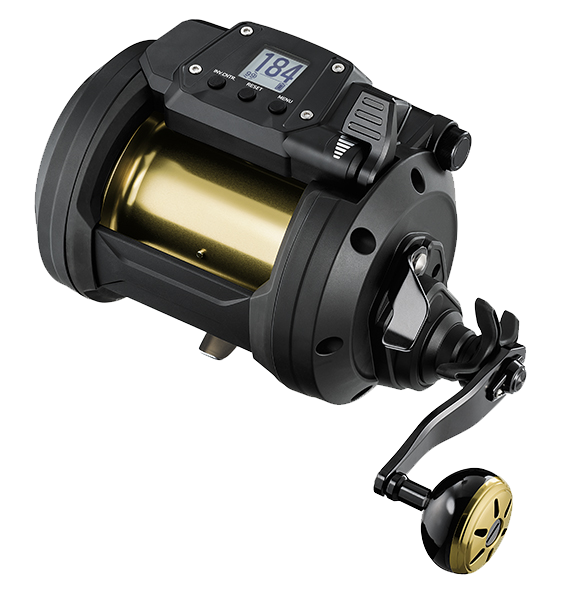
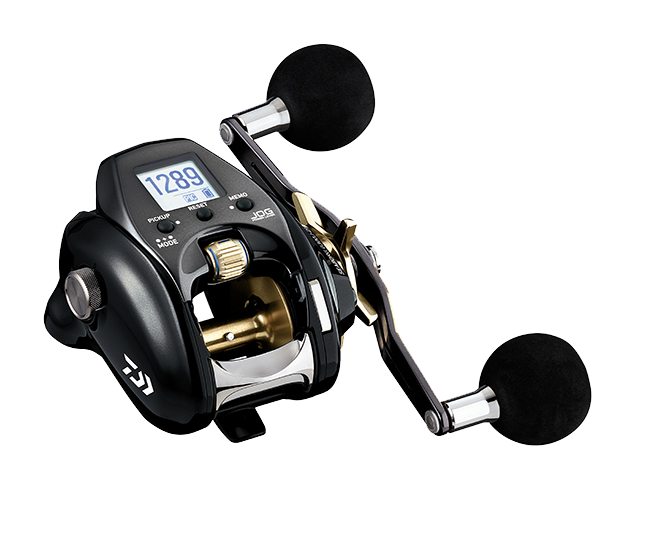
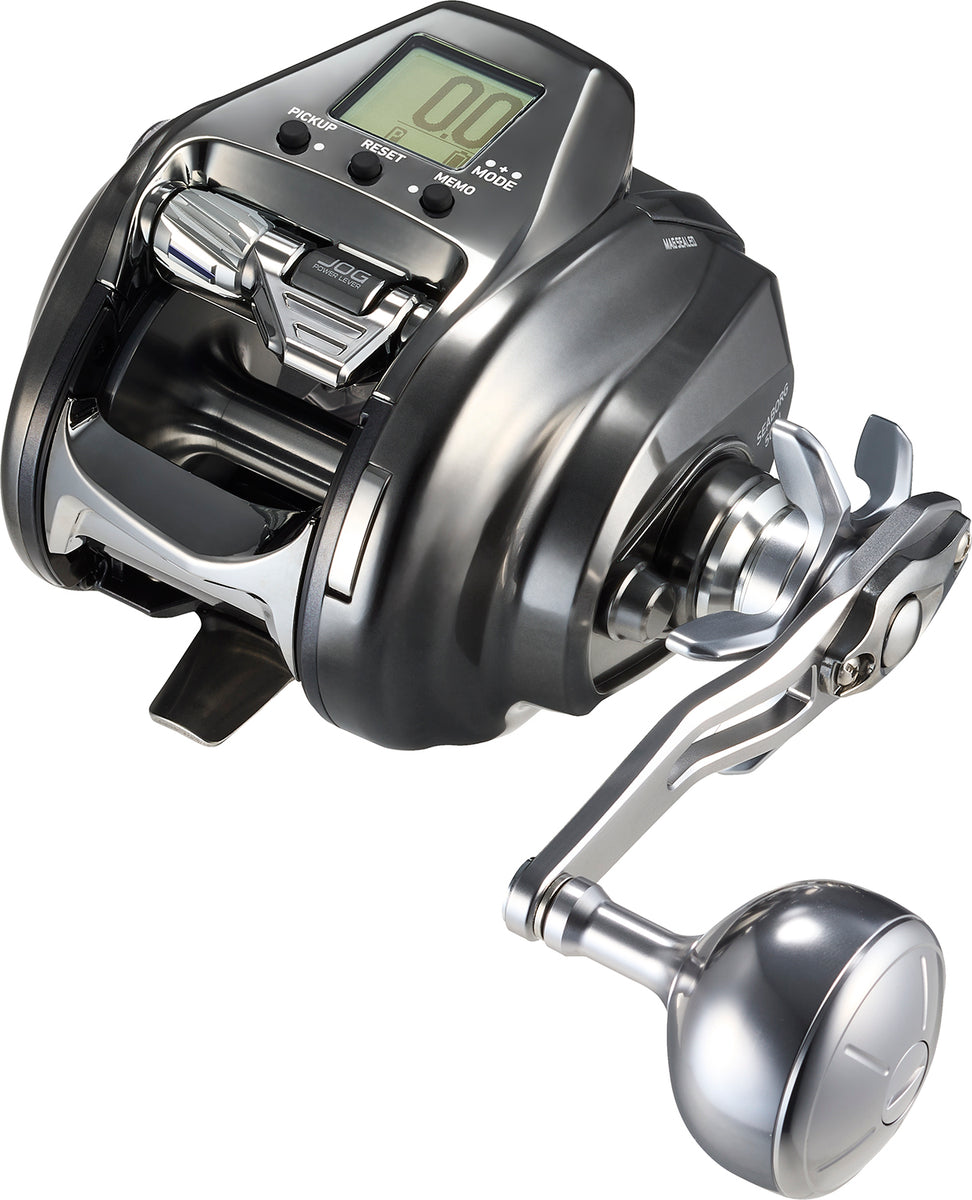
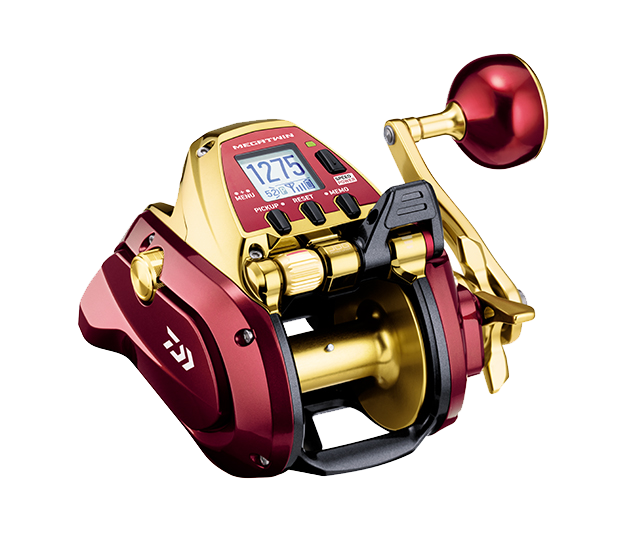
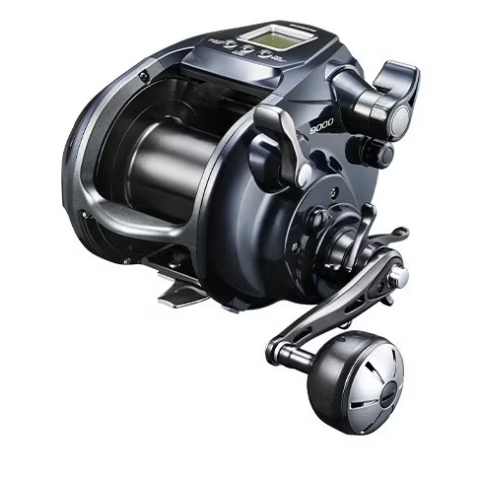
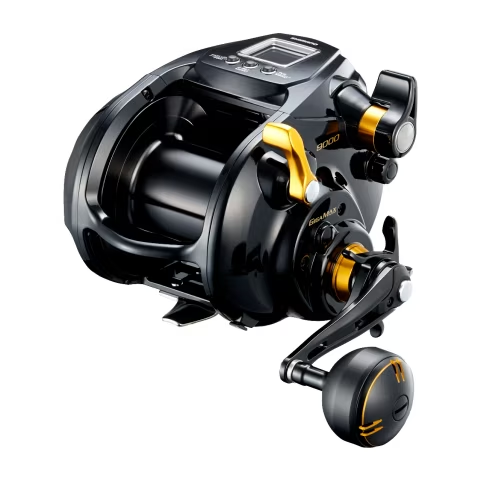
Product images: Daiwa US and Shimano North America Fishing. Each image is matched to the named US model or generation.
Best for deep dropping: match capacity to the rig
Meet the snowy grouper
An ambush predator over reefs and rocky bottom, snowy grouper gives the deep-drop plan a face. Adults are usually uniform dark brown, unlike the white-spotted juveniles. FWC's species profile lists up to 4 ft and 70 lb, with habitat extending to 1,700 ft (checked September 4, 2026). Those are maximum size and habitat figures, not typical catches or a required fishing depth.
Build around your trip's actual grounds and current grouper rules, including the release plan. Then match braid capacity, rod, holder and power to that working depth—the equipment sequence below is where the fish's appeal becomes a practical outfit.
Deep dropping creates the strongest case for power assist. The reel may retrieve a heavy sinker, multi-hook rig and fish through hundreds of feet of water repeatedly. The right comparison begins with line, not maximum drag.
Ask the captain or local tackle shop for:
- Target species
- Typical and maximum depth
- Braid pound test or diameter
- Sinker range
- Expected current and scope
- Required reserve
- Rod-holder and rod recommendation
Depth alone is insufficient. A 1,000-foot vertical number does not include line angle, working reserve or lost terminal tackle.
Daiwa Tanacom 1200: large-capacity value
Range — Tanacom 1200 is the most straightforward recommendation when the buyer wants current US Daiwa support and 1,100 yd of published 80 lb J-Braid capacity without moving directly to Seaborg pricing.
Daiwa also publishes 50 lb maximum drag, 22 lb maximum winding power and 140 m/min maximum retrieval speed. Those are separate specifications; the 22 lb winding figure should not be relabeled as drag.
Choose it for holder-based deep-drop systems where capacity and repeat retrieval matter. Choose a compact Seaborg when the exact line plan fits and fishing the rod in hand is the priority.
If the 1200 reaches the final two, the Tanacom 1200 ownership guide covers the older 1000 comparison, connection clearance, line setup and holder checks.
Shimano Forcemaster 9000 A: high-capacity Shimano value
Reach — Forcemaster carries Shimano's published 1,030 yd of 80 lb PowerPro and 55 lb maximum drag at a displayed US MSRP of $1,189.99 on the verification date.
Shimano positions it for deep-dropping bottom fish and publishes 153 yd/min winding speed on the product page. It is the logical Shimano starting point because the Beastmaster's published capacity and maximum drag are the same.
Shimano Beastmaster 9000 B: premium drivetrain
Endurance — Beastmaster is the upgrade for repeated heavy work, not more spool capacity.
Shimano lists a GigaMax brushless motor, reinforced reduction gear support and Thermo Adjust Drag. Its North American manual publishes a 40 A maximum-current figure and loaded speeds at 1, 10 and 15 kg.
Choose it when those motor, gearing and heat-management differences match the work. For an occasional deep-drop setup, the Forcemaster may leave more of the budget for line, rod and power.
Best for kite fishing: line handling and reset speed
Kite fishing changes the buying criteria. The reel is part of a system that must deploy, retrieve and reset efficiently.
Daiwa Tanacom 1200
Daiwa highlights an oversized line-guide aperture designed to pass large knots and kite swivels. That is a direct functional advantage for kite work, not a generic “more power” claim.
Daiwa Tanacom 750
Use Daiwa's official US Tanacom 750 product page to confirm the current US model, specifications, included equipment, and dealer route. This is a manufacturer link, not an affiliate link.
Daiwa also positions the 750 for kite fishing. Its published 50 lb J-Braid capacity is 770 yd, and the page states that a power cord and reel clamp are included.
Choose between the 750 and 1200 by the boat's line class, connection method and required reserve. The cheaper reel wins when the smaller system fully meets the job.
Shimano Forcemaster and Beastmaster
Shimano specifically positions Forcemaster 9000 A for South Florida kite fishing for sailfish and other pelagics. Beastmaster is positioned for kite and teaser retrieval with the premium motor and drivetrain.
Ask the boat which platform it already supports. Rod, outlet, cable routing and operating habit can matter more than a small specification advantage.
Best for in-hand deep fishing: compact Seaborg
Large electric reels are effective but can turn the outfit into a holder-based tool. Compact Seaborg models aim at a different outcome: keeping the bite and fight in the angler's hands.
Daiwa Seaborg 300J-DH
Use Daiwa's official US Seaborg 300J-DH page to confirm the current model, specifications, availability, and dealer route. This is a manufacturer link, not an affiliate link.
Daiwa positions this model for deep dropping and deep jigging at depths exceeding 1,000 ft. Named target examples include grouper, snapper and tilefish. Published maximum drag is 35 lb.
It is the strongest directional pick when compact control matters, but the exact braid requirement must fit its current US specification.
Daiwa 2026 Seaborg 500J
Use Daiwa's official US 2026 Seaborg 500J page to confirm the current generation, specifications, availability, and dealer route. This is a manufacturer link, not an affiliate link.
Daiwa publishes 440 yd of 50 lb braid and positions the 500J for both in-hand and holder-mounted fishing. Named Atlantic and Gulf targets include snapper, tilefish and grouper; Pacific examples include rock cod, lingcod and halibut.
Choose it over the 300J-DH when additional capacity fits the job. Move to Tanacom 1200 when heavy-line reserve matters more than handheld feel.
Best for teaser retrieval
Shimano explicitly names teaser pulling as a Beastmaster 9000 B use. This is a clearer premium use case than buying Beastmaster solely because it sits above Forcemaster.
The boat should still define the system. Confirm line, teaser load, retrieval cycle, rod or mount, and electrical supply. A 40 A published maximum-current figure demands more planning than the words “12 volt” suggest.
Saltwater durability: read the exact claim
Saltwater readiness is not one universal rating.
Daiwa product pages refer to sealed electronics, washable design, Magsealed bearings on selected Seaborg models and sealed drag systems on Tanacom models. Shimano lists shielded S A-RB bearings, treated A-RB bearings, metal HAGANE bodies and heat-management features depending on model.
Do not turn those named technologies into an invented waterproof rating. Follow the exact manual for connection, washing and storage. Confirm the service route for the US SKU.
After the trip, the electric-reel saltwater maintenance guide separates reel rinsing from cord and connector care so “washable” does not become an instruction to soak every component.
Power facts that change a saltwater setup
| Model | Published electrical fact | What it means for shopping |
|---|---|---|
| Tanacom 750 | 12–16.8 V | Verify source, connector and exact model manual |
| Tanacom 1200 | 12 V power assist stated on US page | Capture exact current limits from the manual before final battery sizing |
| Seaborg 800MJ | 12–16.8 V; 20 A maximum | Boat outlet or battery system must be checked against the published demand |
| Beastmaster 9000 B | DC 12 V; 40 A maximum in North American manual | A generic low-current accessory outlet should not be assumed compatible |
| Forcemaster 9000 A | Full current table not visible in the product-page spec block | Obtain the exact US manual before publishing a battery recommendation |
Runtime cannot be promised from battery amp-hours alone. Load, duty cycle, voltage drop, cable size, connections and battery limits all affect the result.
Use these rows only to eliminate an incompatible setup. The decision hub covers the complete pre-purchase electrical checklist; the battery guide explains runtime estimates and their load and duty-cycle assumptions.
Who can skip buying an electric reel?
You may not need to buy your own electric reel when:
- Fishing is shallow and retrieves are short.
- The outfit must stay light and mobile.
- The boat does not provide a compatible power arrangement.
- You want to try a swordfish trip before buying an outfit. Our daytime swordfish first-trip guide compares boat-supplied, manual and convertible paths before a personal-system purchase. Top Notch Sportfishing in Marathon lists rods, reels and swordfish tackle as included, with personal tackle optional (operator page checked September 4, 2026). Confirm the chosen trip's supplied gear and suitability for your experience before buying your own system.
- Required line capacity and assistance are already covered by existing tackle.
The positive case for electric is more fishing time, less wasted effort retrieving heavy rigs, and access to a method that the angler would otherwise avoid. If it does not create one of those changes, its cost and complexity may not earn a place on the boat.
Build the cart around the fishing method
Monster fish require a load path, not just a powerful reel
A big-fish outfit works as a chain: line enters the guides, the blank bends, the reel seat and butt locate the outfit, and the holder or angler carries that load into the boat. Choosing a reel by maximum drag while leaving the rest as “any heavy rod and holder” does not finish the system.
Daiwa's official Tanacom Dendoh rod range makes the intended architecture visible. The company describes deep-drop blanks with lifting backbone, a Powerlift grip, aluminum reel seat, curved aluminum butt and swivel tip. Its Seaborg Dendoh range is positioned for swordfish, grouper, snapper and other deep targets, with a long bent-butt standard model and a swivel tip intended to reduce awkward angles at boatside. These are examples of functions to match—not proof that one rod fits every reel, holder or target.
Check the system in this order:
- Line path: braid, leader connection and terminal hardware pass the guides and tip used by the boat's method.
- Rod job: the exact rod model covers the captain's sinker range, line class, target and holder-based or in-hand use.
- Reel attachment: reel foot, seat and any supplied clamp fit without improvised spacing or blocked controls.
- Butt and holder: straight or bent butt, diameter, pin/cross arrangement, insertion depth and swivel behavior match the actual holder.
- Boat position: the rod angle, cable route and control access work at the assigned rail position through drop, retrieve and landing.
Ask the boat before buying the rod or holder
Send the captain the exact reel and rod candidates, then ask:
- What line class and sinker range should the rod cover?
- Is the outfit fished in hand, in a fixed holder, or moved between both?
- Does the boat require a straight butt, curved/bent butt, or a specific detachable-butt standard?
- What holder brand/model, inside diameter, depth and locking or pin arrangement is installed?
- Must the holder swivel with the fish or stay fixed for the method?
- Is there clearance for the reel body, handle, power plug and cable at full rod angle?
- Who supplies and installs any backing plate, base or holder change on the boat?
- Where does the outfit move when a fish reaches the transom, and can the swivel tip and leader connection follow that path?
Photographs help: ask for the holder opening, its pin or locking feature, the rail position and nearby power outlet in one frame. Compare those answers with the exact rod and holder drawings before checkout. The goal is a monster-fish system the crew can actually deploy, support and clear—not four impressive components that meet for the first time on fishing morning.
Use the braid capacity guide to fix the line job and the battery guide to fix the power path before treating rod and holder as the final missing pieces.
| Method | Reel decision | Line and rod row | Mounting and power row | Cost that is easiest to miss |
|---|---|---|---|---|
| Deep drop | Enough verified capacity for depth, line class, rig and reserve | Exact braid amount, professional spooling and a rod rated for the working sinker and target | Holder geometry, clamp, cable route and repeated long-retrieve demand | A full heavy-braid load, holder changes and an under-specified power circuit |
| Kite fishing | Line-guide clearance and reset speed fit the boat's kite system | Boat-specified line, knots, swivels and a compatible kite rod | Reel position keeps line and power cable clear during fast resets | Re-rigging around a reel whose guide, connector or placement does not fit the established routine |
| Teaser retrieval | Repeated-load drivetrain and heat-management features have a named job | Teaser line and rod or boom arrangement are confirmed by the crew | Approved continuous-use power path and a safe control position | Paying flagship money before confirming duty cycle, circuit and cockpit workflow |
| In-hand deep jigging | The smallest reel with enough verified line keeps the intended fight in hand | Loaded balance, grip and exact capacity beat maximum model size | Cable moves safely with the angler; battery or outlet does not anchor the outfit awkwardly | Choosing excess capacity that adds loaded weight and defeats the handheld reason to buy |
The cart is complete only when the method still works after reel, line, rod, mounting and power are placed on the actual boat. This is where Electric Reel Lab should beat a model-only guide: the recommendation ends in a working routine, not a reel name.
Final recommendations
- Start with Tanacom 1200 for large-capacity Daiwa deep-drop and kite value.
- Start with Tanacom 750 when its capacity meets the job and the smaller budget matters.
- Start with Seaborg 300J-DH or 500J for a verified-capacity in-hand system.
- Start with Forcemaster 9000 A for Shimano value.
- Upgrade to Beastmaster 9000 B for its motor, drivetrain and heat-management package—not for more line capacity.
- Choose Seaborg 800MJ when switchable high/low control solves a defined premium job.
For the other shortlisted reels, use the linked official US model pages above to confirm the exact model and current dealer route.
Sources
- Daiwa US Tanacom 1200: https://daiwa.us/collections/reels/products/tanacom-1200 (accessed 2026-09-01)
- Daiwa US Tanacom 750: https://daiwa.us/products/tanacom-750/1000 (accessed 2026-09-01)
- Daiwa US Seaborg 300J-DH: https://daiwa.us/collections/reels/products/seaborg-300j (accessed 2026-09-01)
- Daiwa US 2026 Seaborg 500J: https://daiwa.us/collections/price-over-500/products/2026-seaborg-500j (accessed 2026-09-01)
- Daiwa US Seaborg 800MJ: https://daiwa.us/collections/price-over-500/products/seaborg-800-m (accessed 2026-09-01)
- Shimano US Forcemaster A: https://fish.shimano.com/en-US/product/reels/specialized/electric/a075f00003dsykuqap.html (accessed 2026-09-01)
- Shimano US Beastmaster 9000 B: https://fish.shimano.com/en-US/product/reels/specialized/electric/a075f00003zdna8qam.html (accessed 2026-09-01)
- Shimano Beastmaster 9000 B manual: https://fish.shimano.com/content/dam/Shimanofish/LocalNA/Contentsrelated/manuals/IM_BEASTMASTER_9000_B.pdf (accessed 2026-09-01)
- Daiwa US Tanacom Dendoh Rods: https://daiwa.us/products/tancom-dendoh-rods (accessed 2026-09-03)
- Daiwa US Seaborg Dendoh Rod: https://daiwa.us/products/new-seaborg-deep-drop-rod-dendoh-style (accessed 2026-09-03)